Advantech AFE-R750 with JetPack 6.1
Instruction
TechNexion Embedded Vision Solutions provide embedded system developers access to high-performance, industrial-grade camera solutions to accelerate their time to market for embedded vision projects.
Supported Camera Modules
| Camera Series | Products |
|---|---|
| VLS-GM2 | VLS-GM2-AR0144 VLS-GM2-AR0145 VLS-GM2-AR0234 VLS-GM2-AR0235 VLS-GM2-AR0246 VLS-GM2-AR0521 VLS-GM2-AR0522 VLS-GM2-AR0544 VLS-GM2-AR0821 VLS-GM2-AR0822 VLS-GM2-AR0830 VLS-GM2-AR1335 VLS-GM2-AR2020 |
More Camera Products Details...
Supported NVIDIA Jetson Partner Platforms
Install TN Camera on NVIDIA Jetson Partner Platforms
Connect to NVIDIA Jetson Partner Platforms
VLS-GM2 cameras on Advantech AFE-R750
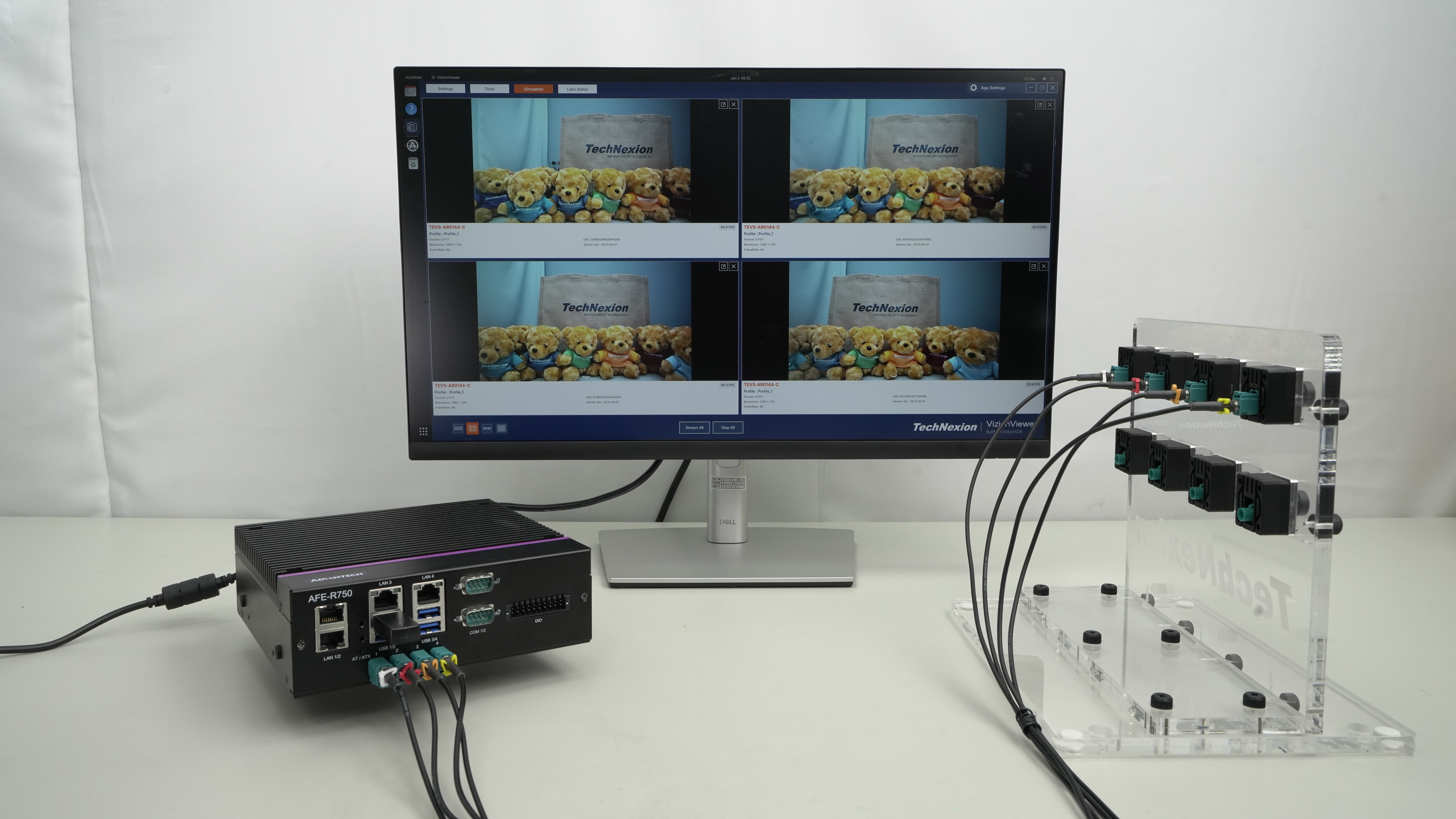
Connect VLS-GM2 cameras to the AFE-R750 GMSL ports.
Using TechNexion Pre-built modules
We recommend following the user manual from platform vendors to set up the system. After that, you can follow the below method to install TechNexion Cameras Driver.
-
Download pre-built modules.
$ wget https://download.technexion.com/demo_software/EVK/NVIDIA/AFE-R750/OrinNX/pre-built-modules/lastest/JP61/tn_camera_modules_jp61.tar.gz -
Uncompress the modules.
$ tar -xf tn_camera_modules_jp61.tar.gz -
Run installation script.
$ cd tn_camera_modules_<built_time>/
$ ./tn_install.sh -
After you agree to continue the installation, select the camera PHY mode. The module will be installed to the system.
$ ./tn_install.sh
****** TechNexion Camera Driver Installation ******
This installs AFE-R750 Orin NX camera modules and DTBO overlays.
Back up the image before installing on a production system.
Do you want to continue?[Y/n] Y
Camera PHY mode [single/dual] (default: single): single
Selected camera PHY mode: single
Selected default extlinux label: afe-r750-camera
Selected default DTBO: tegra234-p3767-camera-afe-r750-vls-gm2-overlay.dtbo
Installed artifacts:
<sha256>  /lib/modules/5.15.148-tegra/updates/drivers/media/i2c/technexion/maxim-gmsl/max96712_tn.ko
<sha256>  /lib/modules/5.15.148-tegra/updates/drivers/media/i2c/technexion/maxim-gmsl/max96717.ko
<sha256>  /lib/modules/5.15.148-tegra/updates/drivers/media/i2c/technexion/tevs/tevs.ko
<sha256>  /boot/tegra234-p3767-camera-afe-r750-vls-gm2-overlay.dtbo
<sha256>  /boot/tegra234-p3767-camera-afe-r750-vls-gm2-fsync-overlay.dtbo
<sha256>  /boot/tegra234-p3767-camera-afe-r750-dual-phy-vls-gm2-overlay.dtbo
<sha256>  /boot/tegra234-p3767-camera-afe-r750-dual-phy-vls-gm2-fsync-overlay.dtbo
Extlinux camera entries:
DEFAULT afe-r750-camera
LABEL afe-r750-camera
      FDT /boot/dtb/kernel_tegra234-p3768-0000+p3767-0000-nv.dtb
      OVERLAYS /boot/tegra234-p3767-camera-afe-r750-vls-gm2-overlay.dtbo
LABEL afe-r750-camera-fsync
      FDT /boot/dtb/kernel_tegra234-p3768-0000+p3767-0000-nv.dtb
      OVERLAYS /boot/tegra234-p3767-camera-afe-r750-vls-gm2-fsync-overlay.dtbo
LABEL afe-r750-camera-dual-phy
      FDT /boot/dtb/kernel_tegra234-p3768-0000+p3767-0000-nv.dtb
      OVERLAYS /boot/tegra234-p3767-camera-afe-r750-dual-phy-vls-gm2-overlay.dtbo
LABEL afe-r750-camera-dual-phy-fsync
      FDT /boot/dtb/kernel_tegra234-p3768-0000+p3767-0000-nv.dtb
      OVERLAYS /boot/tegra234-p3767-camera-afe-r750-dual-phy-vls-gm2-fsync-overlay.dtbo
Finish Camera Driver Installation.
You should reboot the device to enable AFE-R750 cameras.
Do you want to reboot now?[Y/n] Y
Rebooting...
You should reboot the device after installation.
Bring up Camera
TechNexion VizionViewer
Gstreamer
If you successfully initialize the camera, you can follow the steps to open the camera.
-
Check the supported resolutions:
$ gst-device-monitor-1.0 Video/Source
Probing devices...

Device found:

        name  : vi-output, tevs 9-0039
        class : Video/Source
        caps  : video/x-raw, format=UYVY, width=640, height=480, framerate=60/1
                video/x-raw, format=UYVY, width=1280, height=720, framerate=60/1
                video/x-raw, format=UYVY, width=1280, height=800, framerate=60/1
                video/x-raw, format=NV16, width=640, height=480, framerate=60/1
                video/x-raw, format=NV16, width=1280, height=720, framerate=60/1
                video/x-raw, format=NV16, width=1280, height=800, framerate=60/1
        properties:
                object.path = v4l2:/dev/video0
                device.api = v4l2
                media.class = Video/Source
                api.v4l2.path = /dev/video0
                api.v4l2.cap.driver = tegra-video
                api.v4l2.cap.card = "vi-output\,\ tevs\ 9-0039"
                api.v4l2.cap.bus_info = platform:tegra-capture-vi:0

... -
Bring up the camera (/dev/video0) with 1280x720 by Gstreamer pipeline:
$ DISPLAY=:0 gst-launch-1.0 v4l2src device=/dev/video0 ! \
"video/x-raw, format=UYVY, width=1280, height=720" ! xvimagesink sync=false
Troubleshooting
-
Cannot find cameras
If you cannot bring up the cameras, you can check if the video device does exist.
$ ls /dev/video*  # List all video devices
/dev/video0  /dev/video1  /dev/video2  /dev/video3
If you cannot see the devices, you should check if the drivers have been probed.
-
Occur Error: Could not get EGL display connection
If you encounter the error nvbufsurftransform: Could not get EGL display connection by running the Gstreamer command, you can modify the parameter
DISPLAYby the command:# Check and Set environment parameter for 'DISPLAY'
$ export DISPLAY=$(w| tr -s ' '| cut -d ' ' -f 3 | grep :)
# Run Gstreamer pipeline
$ gst-launch-1.0 v4l2src device=/dev/video0 ! \
"video/x-raw, format=UYVY, width=1280, height=720" ! xvimagesink sync=false -
CPU overload when camera streaming
If you open the camera stream and find that the CPU load is too large, it may be because Gstreamer does not use the GPU. You have to install some NVIDIA plug-in tools on Gstreamer.
$ sudo apt update && apt depends nvidia-jetpack | awk '{print $2}' | uniq | xargs -I {} bash -c "sudo apt -o Dpkg::Options::="--force-confold" -y install {} ; sudo apt clean"